Skills Shortage List Australia: Occupations in Demand in 2026
Published 20 Jul 2026
Skills Shortage List Australia: Occupations in Demand in 2026
 Meghan Fernandes
Nearly one in three advertised positions across Australia goes unfilled. According to Jobs and Skills Australia’s Survey of Employers who Recently Advertised (SERA), the national vacancy fill rate fell to 68.2% in March 2026. The shortage is most acute in the trades, health, technology and community services, and it is more severe in regional Australia than in metropolitan areas.
For job seekers, the shortage list identifies where employers struggle to fill vacancies and where holding the right qualification puts you in a strong position in the Australian labour market.
What does Australia’s occupation shortage data tell us?
The Jobs and Skills Australia Occupation Shortage List (OSL) is the primary reference for occupation shortages in Australia. It assesses more than 1,000 occupations across Skill Levels 1 to 4 using the Australian and New Zealand Standard Classification of Occupations (ANZSCO). The 2025 OSL, released on 15th October 2025, confirmed that 293 of 1,022 assessed occupations, approximately 29%, are currently in shortage nationwide. In 2024, the figure was 33%, indicating the overall shortage rate has eased slightly, though significant gaps remain across key industries.
Each occupation on the OSL is assessed against three key indicators:
-
Vacancy fill rate – the percentage of advertised vacancies that employers successfully fill
-
Qualified applicants per vacancy – applicants who meet the role’s qualification requirements
-
Suitable applicants per vacancy – applicants deemed ready to start the job
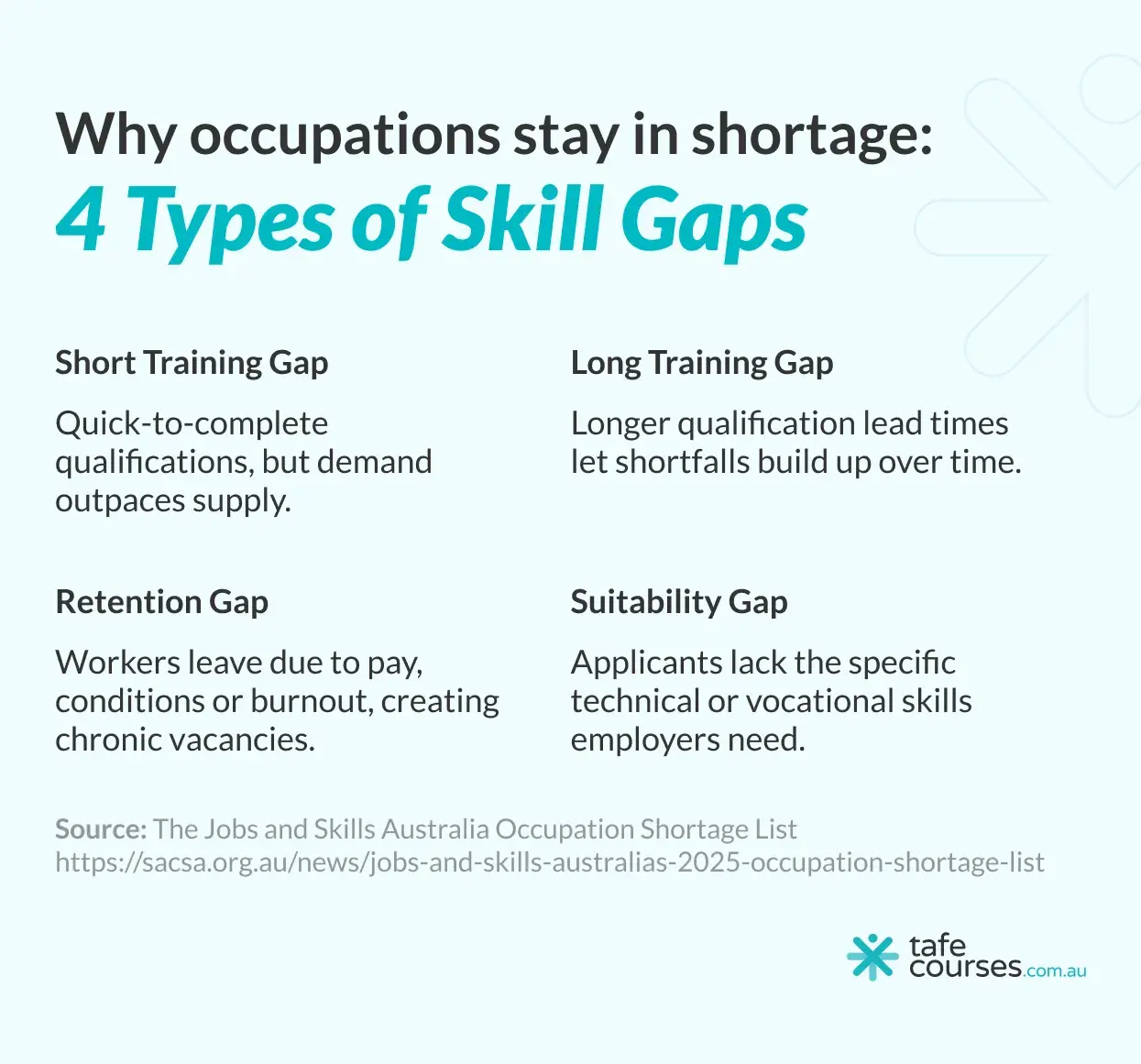
Occupations that consistently fail to attract enough qualified applicants are classified as in shortage. The OSL identifies four shortage types that explain why gaps persist:
-
Short training gap – qualifications can be completed quickly, but demand is outpacing supply
-
Long training gap – longer lead times for qualifications mean workforce shortfalls accumulate over time
-
Retention gap – workers leave roles due to conditions, pay, or burnout, creating chronic vacancies
-
Suitability gap – applicants lack the specific technical or vocational skills employers need
The OSL informs immigration policy, including the skilled occupation list used for visa pathways, as well as government training investment and workforce planning across the public and private sectors.
What does the March 2026 occupation shortage data show?
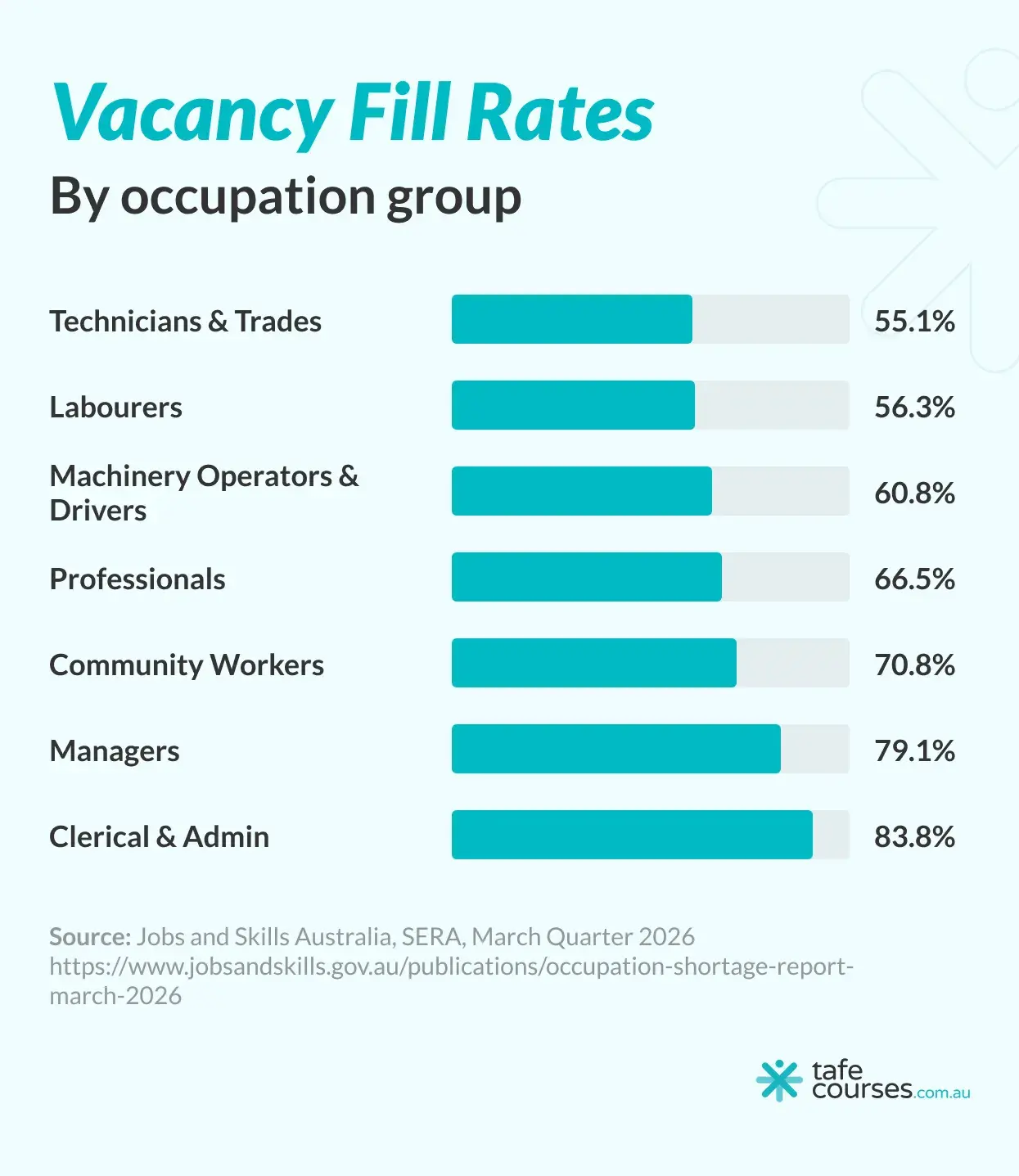
The March 2026 SERA results confirm vacancy fill rates across most major occupation groups over the past year. The results covered more than 20,000 vacancies across 11,000 surveys in the past 12 months. The regional shortage is more severe than the metropolitan shortage, with the gap between the two widening to its largest point in the SERA data series.
March Quarter 2026 – National Snapshot
| Metric | March Q 2026 | Change over 12 months |
|---|---|---|
| National vacancy fill rate | 68.2% | ▼ 3.3 pts |
| Metropolitan fill rate | 69.7% | ▼ 3.4 pts |
| Regional fill rate | 65.0% | ▼ 2.9 pts |
| Technicians and Trades Workers fill rate | 55.1% | ▼ 1.1 pts |
| Professionals fill rate | 66.5% | ▼ 5.3 pts |
| Skill Level 3 fill rate (lowest of all groups) | 55.5% | ▲ 1.2 pts |
Employers are receiving fewer suitable and qualified applicants per vacancy than at any point in the past two years. The primary driver is a lack of qualified applicants, combined with retention challenges, consistent with the retention gap and suitability gap classifications in the OSL. The regional shortage gap widened to 4.6 percentage points, the largest metro-regional divide in the SERA data series.
Occupation shortage list Australia: Quick reference table
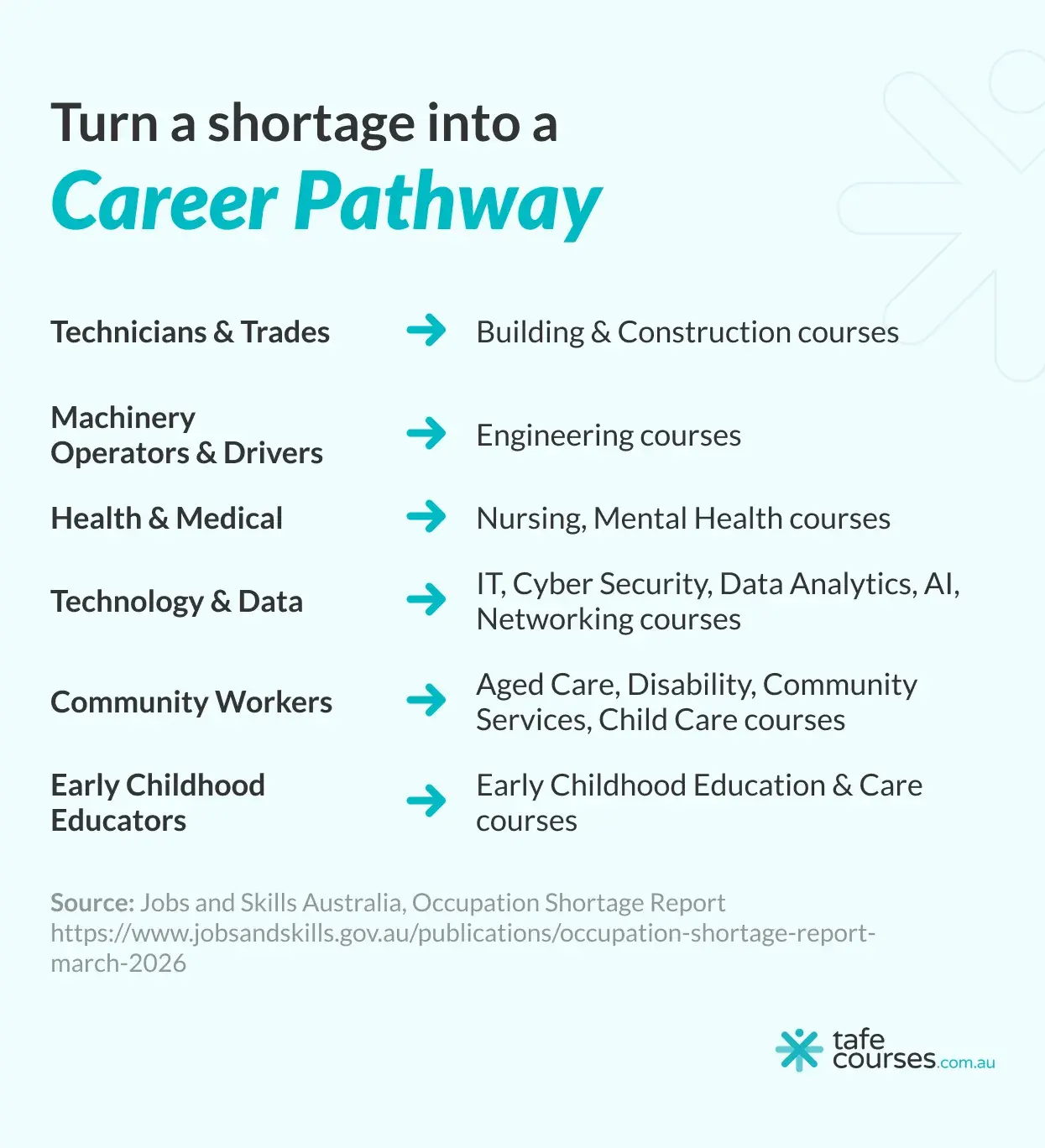
| ANZSCO Major Group | Fill Rate (Mar Q 2026) | 12-Month Trend | Relevant TAFE/RTO Courses |
|---|---|---|---|
| Technicians and Trades Workers | 55.1% | ▼ 1.1 pts | Building and Construction courses |
| Labourers | 56.3% | ▲ 0.5 pts | Building and Construction courses |
| Machinery Operators and Drivers | 60.8% | ▼ 9.4 pts | Engineering courses |
| Professionals | 66.5% | ▼ 5.3 pts | Nursing courses Mental health courses Cyber security courses Data analytics courses IT courses |
| Community Workers | 70.8% | ▲ 3.4 pts | Aged care courses Disability courses Community services courses Child care courses |
| Managers | 79.1% | ▲ 2.7 pts | Leadership and management courses Hospitality courses |
| Clerical and Administrative Workers | 83.8% | ▲ 2.6 pts | Business administration courses Health administration courses |
Why are technicians and tradespeople the hardest occupations to fill?
Technicians and trades workers recorded the lowest vacancy fill rate of any ANZSCO major group at 55.1%. Shortages are particularly concentrated here: broad industry shortages in construction and mechanical services are dragging down productivity across the sector. These are Skill Level 3 occupations, with standard entry qualifications of Certificate III and Certificate IV.
The data shows the applicant pipeline is shrinking, not growing:
-
Total applicants per vacancy fell by 2.9 over 12 months
-
Qualified applicants per vacancy fell by 0.9 over 12 months
-
Employers struggle not only to fill vacancies but also to attract applicants who meet basic qualification requirements
The regional shortage in this group is even more acute. Skill Level 3 occupations recorded a regional fill rate of 52.9%, compared with 57.3% in metropolitan areas, a 4.4 percentage point gap. For job seekers in regional Australia, a trades qualification represents the most direct entry into a high-shortage field.
Trades within this major occupation group include roles in construction, air conditioning and mechanical services, electrical work and plumbing. Occupations such as mechanical services and plumber appear repeatedly across OSL results due to persistent shortages across multiple states and territories.
Which professions are facing increasing shortage pressure?
The professionals major group covers health, community health, technology, education and business services. It recorded the steepest 12-month fill rate decline of any ANZSCO category. Total applicants per vacancy fell by 3.9 over 12 months, the largest applicant pool decline in the report. High demand combined with retention challenges and long training pathways is creating intense competition for skilled workers across this group.
Shortages are particularly concentrated in high-skilled professional roles. Specific occupations identified on the JSA occupation shortage list across multiple states and territories include roles in mental health, general medicine, medical practice management, critical care and surgical nursing. Technology roles are equally affected: the rapid evolution of technology is outpacing the supply of experienced IT professionals, with digital skills ranked as the highest priority by businesses and roles such as software engineer and cyber security specialists facing qualification gaps.
Health and medical occupations in shortage
Healthcare shortages are driven by an ageing population and high burnout rates. This is called a retention gap dynamic that creates sustained demand for new entrants. VET qualifications provide direct entry into several in-demand health roles.
| Qualification | Role Pathway |
|---|---|
| Certificate III in Health Services Assistance | Entry point for hospital and clinical support roles |
| Certificate IV in Mental Health | Mental health support and community health |
| Diploma of Nursing | Primary VET entry point for enrolled nursing roles |
| Certificate IV in Allied Health Assistance | Physiotherapy, occupational therapy, and rehabilitation support |
| Certificate III in Dental Assisting | Entry into dental practice roles |
| Diploma of Practice Management | Administration and management in medical practice and family health settings |
| Certificate IV in Health Administration | Medical reception and health administration roles |
| Diploma of Counselling | Counselling, community health, and mental health support |
Technology and data roles in shortage
ICT professionals are among the most consistently listed occupations across OSL results. Roles in cyber security, data analytics, and networking are identified as shortage occupations across most states and territories. VET qualifications provide a faster entry point than a university degree for many of these high-demand roles.
| Qualification | Role Pathway |
|---|---|
| Certificate III in Information Technology | Entry-level IT support, systems, and networking |
| Certificate IV in Information Technology | Network administration, cyber security, and systems support |
| Diploma of Information Technology | Intermediate to advanced roles in networking, cloud, and cyber security |
| Cyber Security courses | Specialist pathways into one of the most shortage-affected ICT unit groups |
| Data Analytics courses | Growing demand across all sectors for data professionals |
| Artificial Intelligence courses | Emerging shortage area as AI adoption accelerates across Australian industry |
| Networking courses | Consistently shortage-affected occupation across metropolitan and regional areas |
What is the demand for community and personal service workers?
Community and personal service workers recorded a fill rate of 70.8%, which was above the national average. This group’s fill rate improved by 3.4 percentage points over 12 months, with suitable applicants per vacancy increasing by 1.7 percentage points, the strongest gain of any major group in the dataset.
The improvement reflects increased enrolment in aged care, disability, and community services training in recent years. However, vacancy volumes remain significant. Sustained demand from an ageing population and the ongoing national rollout of the NDIS mean workforce requirements for personal service workers will continue to grow through the decade.
Roles in this group include workers from the aged care, disability support, personal service and community health sector, and they don’t require university degrees. Certificate III and Diploma qualifications are the standard VET entry pathways, with courses accessible at locations across metropolitan and regional Australia.
| Qualification | Role Pathway |
|---|---|
| Certificate III in Individual Support | Ageing, disability, and home and community care |
| Certificate III in Aged Care | Direct entry into aged care facilities and in-home support |
| Certificate IV in Disability | Disability support, including developmental disability services |
| Diploma of Community Services | Case management, community health, and coordination roles |
| Certificate IV in Youth Work | Working with young people in community and welfare settings |
| Certificate IV in Alcohol and Other Drugs | Counselling and support roles in drug and alcohol services |
| Diploma of Counselling | Community health and counselling practice |
Is there a shortage of early childhood education support workers?
Child care workers and pre-primary school teachers have appeared on the JSA occupation shortage list across multiple consecutive years in most states and territories. Demand is structural: early childhood services operate under a regulated framework with mandated staff-to-child ratios and workforce supply has not kept pace with sector growth. Low applicant numbers and retention challenges contribute to the chronic shortages in this area, which is consistent with both the Short Training Gap and Retention Gap classifications.
Under ACECQA requirements, working in regulated early childhood settings requires a minimum nationally approved qualification. Teacher’s aide and learning support roles are also in consistent demand across most states, with retention challenges driven by long training pathways and difficult working conditions meaning new entrants with the right qualifications are consistently in demand.
| Qualification | Role Pathway |
|---|---|
| Certificate III in Early Childhood Education and Care | Minimum qualification for educators in regulated settings, including centre-based and family day care |
| Diploma of Early Childhood Education and Care | Required for room leader and educational leader roles |
| Certificate III in Education Support | Teacher’s aide and learning support roles in school settings |
| Certificate IV in Education Support | Advanced learning support and specialised student assistance |
| Training and Assessment | Delivering workplace training and VET programs |
Which other occupation groups are under pressure?
Two additional major groups in the SERA data show significant deterioration.
Machinery operators and drivers recorded a fill rate of 60.8% – the second-lowest across all major groups. Fill rates fell by 9.4 percentage points over 12 months, the largest annual decline in the dataset, with total applicants per vacancy falling by 6.8. This group covers roles in manufacturing, mining, forestry, and transport logistics.
Labourers recorded a fill rate of 56.3%, among the lowest in the dataset, though the 12-month trend was relatively stable. This group includes roles in construction, manufacturing, and agriculture.
Both groups are relevant to job seekers considering entry-level or semi-skilled roles in industries with structural labour shortages.
Which qualification is the right starting point?
Your next step
The occupation shortage list shows where employers cannot find qualified workers. For job seekers, this directly informs training decisions: a qualification tied to a shortage occupation carries stronger job prospects and often faster pathways to employment than one in an oversupplied field.
- Identify the major group or specific occupation that aligns with your background or interests.
- Check its shortage status against the JSA Occupation Shortage List or SERA results, noting whether the shortage is rated national, regional, or state-specific, since this affects where the job prospects are strongest.
- Confirm the AQF level and entry requirements for the corresponding qualification. Some shortage occupations require a Certificate III as a minimum; others a Diploma or higher.
- Search for the corresponding qualification on tafecourses.com.au and enquire about a course to get connected with the right training provider.


Not sure which course to choose? Let us recommend the best courses to suit you!



Subscribe to Our Newsletter
Get expert advice, insights, and explainers on tricky topics — designed to help you navigate your learning journey with confidence.
By submitting this enquiry I accept the "Privacy Policy" and "Terms of Use"


