20 Jobs You Don’t Need Experience For: Learn While You Earn
Published 25 May 2023
Nutritionist vs Dietitian: What’s the Difference?
 Michael Yi
 The difference between a nutritionist and a dietitian might seem hard to spot.
They might sound like two different terms for the same thing – professionals who offer advice in public health.

Joel Feren, Dietitian
The Nutrition Guy
“Dietitians and nutritionists apply the art and science of nutrition to help people better understand the link between food and health.
Further, they assist by encouraging dietary changes to achieve and maintain optimal health and prevent and treat illness and disease. Nutrition professionals are qualified to understand food science, interpret nutrition science, assess individual nutritional requirements, counsel on diet for ideal health or various illnesses, perform nutrition research, and instigate nutrition services and programs.”
But there are clear distinctions that separate the two career paths, and if you’re thinking of becoming a nutritionist, you should understand what they are. They have different job descriptions because their qualifications offer different types of services according to their levels of qualification.
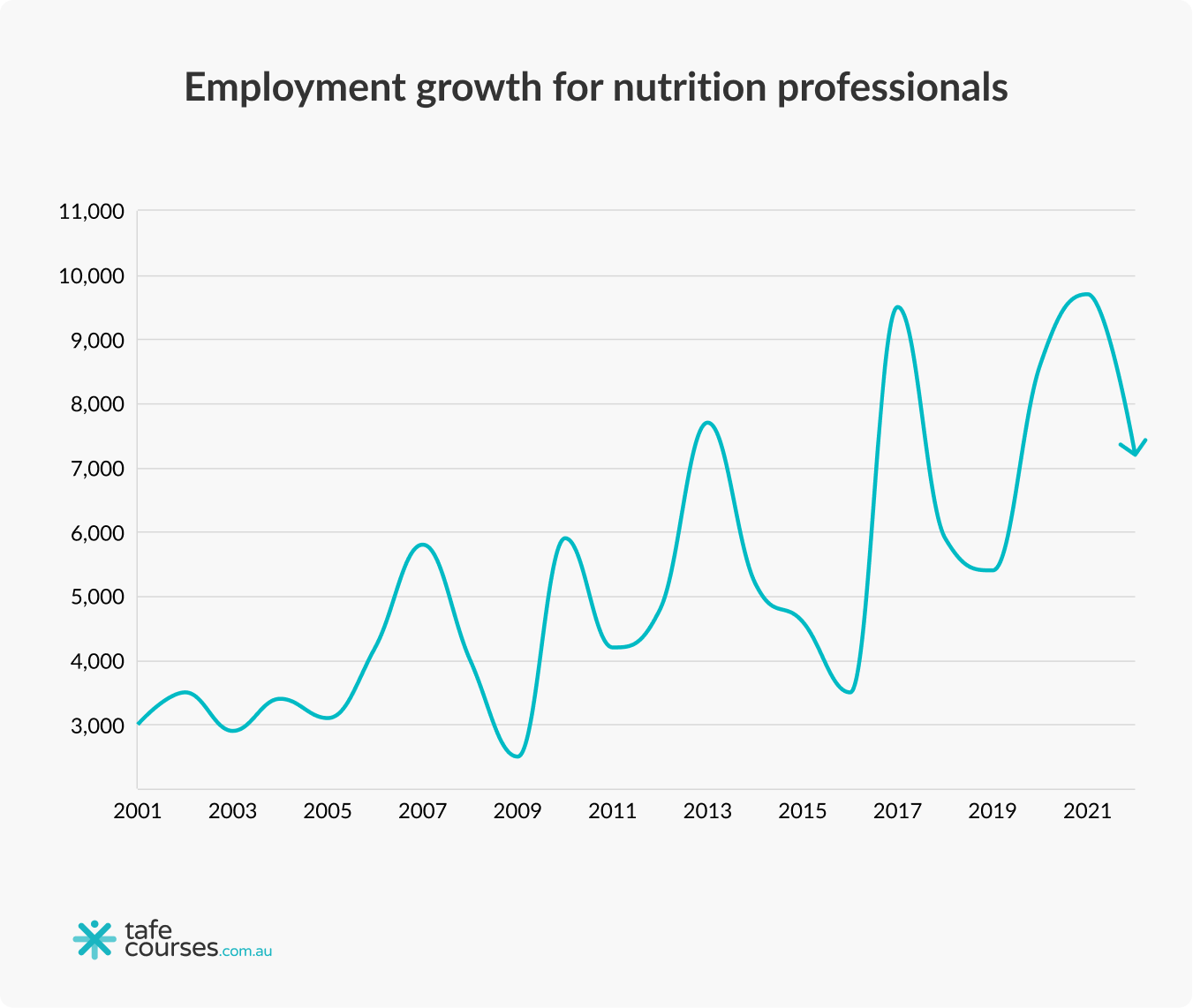
Both have seen strong employment growth over the past 20 years.
Nutritionists vs dietitians
“In Australia, there is a clear difference between dietitians and nutritionists,” Joel says.
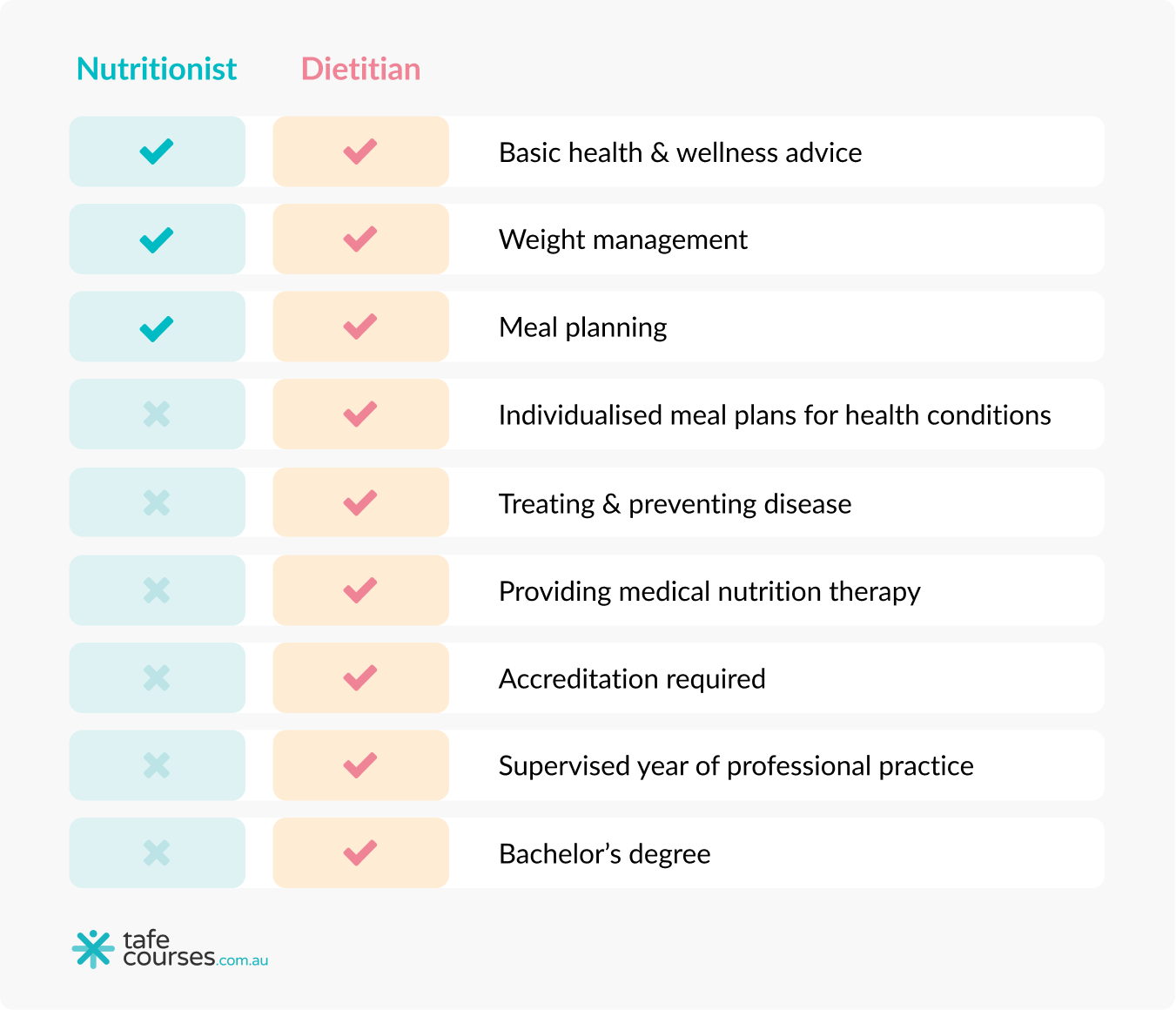
“Accredited Practising Dietitians (APDs) have often studied for at least four years and completed a qualification in human nutrition. They undertake supervised and professional experience in clinical nutrition, community health and food service.”
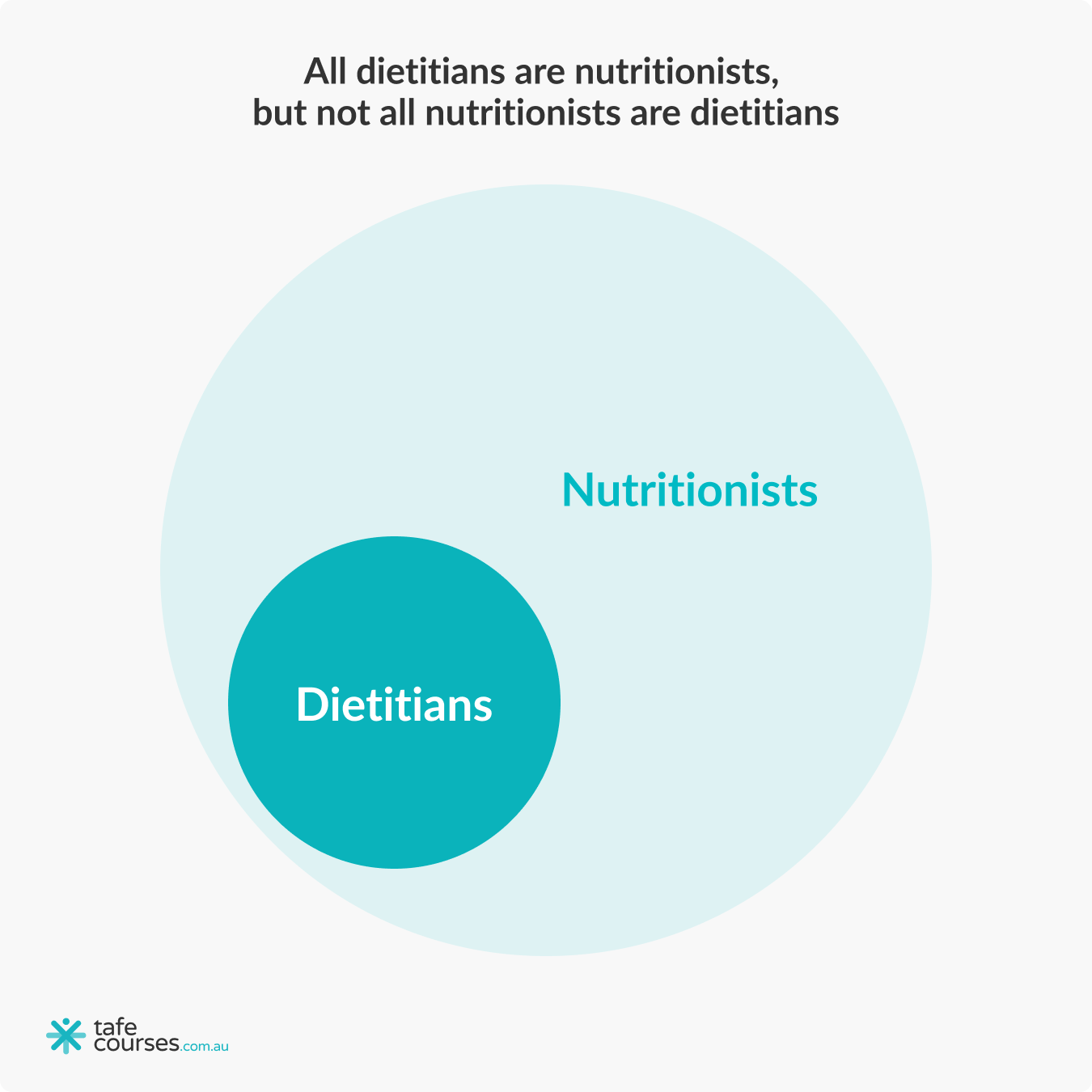
“Nutritionists do not complete this professional experience as part of their study. All dietitians are obliged to undertake regular professional development to maintain their accreditation. All APDs are considered to be nutritionists. However, nutritionists without a dietetics degree cannot assume the title of a dietitian.”
What do nutritionists do?
A nutritionist’s role is to help their clients by providing advice and encouragement. They provide a healthier lifestyle for their clients by:
While you might assume all nutritionists have undertaken an appropriate nutrition course, that isn’t always the case.
Since “nutritionist” is not a protected term in Australia, anyone can call themselves a nutritionist and offer nutrition services without any extensive qualifications.
This lack of regulation means that anyone from a nutrition graduate to someone with little nutrition training can self-proclaim their expertise. This is because there are no specific requirements that need to be met to claim the job title.
Just because the term is unregulated doesn’t mean that nutritionists are any less trustworthy or skilled – it just means that their job title doesn’t necessarily prove their extensive knowledge.
Many people employed in health and wellness – personal trainers, for example – will undertake base level nutrition courses so that they can expand the services they offer. Taking these courses means that they can help explain the basics of food science to their clients, which allows the average person to digest that information more easily.
If you’re after base level guidance for your food choices, a nutritionist can offer those services to you. However, a nutritionist can’t advise you if your needs fit outside the box. For example, if you need a tailored meal plan based on your food allergies, a nutritionist is not equipped with that level of expertise.
This situation is when you need a dietitian. Nutritionists aren’t always qualified to give dietary advice to help treat or manage specific dietary requirements or diseases, while a dietitian can. All dietitians are nutritionists, but not all nutritionists are dietitians.
What do dietitians do?
Dietitians are qualified to offer food science expertise on a more advanced level than the average nutritionist. A dietitian can offer all the same services a nutritionist can, and additionally, provide for clients by:
Dietitians are allowed to provide these more advanced services to their clients because they are required to complete a course of study in nutrition, while nutritionists are not. Additionally, dietitians have to complete at least a full year of supervised work in professional practice before being granted their position.
Joel Feren, Dietitian
The Nutrition Guy
“Both dietitians and nutritionists take a holistic approach to a client’s health and nutrition and aim to implement a healthy eating plan based on the inclusion of a variety of foods from the various food groups. However, a dietitian is best placed to provide medical nutrition advice to manage disease states.”
“I chose to become a dietitian because it afforded me more work opportunities and allowed me to have a more clinical focus.”
To qualify as an accredited practicing dietitian in Australia you have to be registered with nationally recognised bodies like the Dietitians Association of Australia or the Nutrition Society of Australia. To register with associations like DAA or NSA, you are required to meet certain standards and complete an accredited Bachelor’s degree in dietetics, qualifying you and your specialisation in food science.
As an APD, you’re qualified to work beyond the workplace of nutritionists, meaning that you can work in clinical nutrition settings, like hospitals, community health centres, and private health care facilities.

Nutritionist and Dietitian Careers in Australia: A Beginner’s Guide
Learn everything you need to know about the field of nutrition and dietetics. Discover the steps you need to take to become a nutritionist or dietitian.
Read More
Why study nutrition and dietetics?
Whether you pursue a career as a nutritionist or a dietitian is entirely dependent on where your personal interest in health and wellness lies.
If you’re into health and wellbeing but feel more compelled by the fitness side of things, pursue nutrition. Education programs can be as short as six weeks, and if you pursue a career in personal training, your nutritionist qualification will be an asset to your business.
But if it’s food science and clinical treatment that you’re fascinated by, pursue dietetics! Help people with health issues on a more advanced level, in medical nutrition.
People pursue dietetics because they love it and it shows when it comes to job satisfaction. A 2018 Victorian Dietetics Workforce Report showed that a whole 72% of dieticians intended to stay within their profession for six years plus. Getting accredited as a dietitian pays off.
Browse Nutrition Results
Top Result
Diploma of Nursing (SA Only) HLT54121
Build a meaningful career that makes a difference with the HLT54121 Diploma of Nursing. This nationally recognised qualification provides the essential skills, knowledge, and practical training needed to become a qualified Enrolled Nurse in Australia....

in partnership with

Study Method Blended
Location Adelaide South Australia
Job Outcomes Enrolled Nurse
in partnership with
Graduate Diploma in Management
The Graduate Diploma in Management is an online postgraduate qualification that is ideal for busy senior managers, with a potential entry pathway through any of our Graduate Certificates and study that is highly supported, fits into your schedule, and...

Study Method Blended, Online, Virtual
Location Canberra ACT +6
Job Outcomes People Management +3
Graduate Certificate in Management
The Graduate Certificate in Management is an online postgraduate qualification that is designed for newer and ambitious professionals, with entry possible through management experience alone and a study structure that easily accommodates full-time work...
Study Method Blended, Online, Virtual
Location Adelaide South Australia +4
Job Outcomes People Management +3
Certificate III in Community Services (WA Only) CHC32015
The Certificate III in Community Services is perfect for entry level community services workers who support individuals through the provision of person-centred services. Work may include day-to-day support of individuals in community settings or suppor...

Study Method In-class
Location Perth Western Australia +1
Job Outcomes Community Support Worker +3
Bachelor of Health Science (Naturopathy)
Naturopathy is a whole medical system combining theory (philosophy and principles) and practise that uses an array of natural therapies to support healing and maintain health. Naturopaths aim to treat the underlying causes of illness and disease. The c...
Study Method Blended
Location Adelaide South Australia +5
Job Outcomes Naturopath
Bachelor of Health Science (Clinical Nutrition)
Clinical nutritionists integrate traditional food wisdom and current scientific evidence to motivate individuals and communities to eat well and live healthier lives. The Bachelor of Health Science (Clinical Nutrition) is supported by a strong underpin...
Study Method Blended
Location Adelaide South Australia +5
Job Outcomes Clinical Nutritionist corpor... +1
Certificate III in Individual Support (Ageing OR Disability) (Perth Only) CHC33021
If you have a passion for helping those most in need, this qualification is one way you can utilise your knowledge for the benefit of others. Package the Certificate III in Individual Support (Ageing or Disability) (CHC33021) to save time and gain know...
Study Method In-class
Location Perth Western Australia +2
Job Outcomes Care Assistant +4
Certificate lll in Early Childhood Education & Care (Perth Only) CHC30121
If you love working with children and want to learn more about providing quality education and care in a range of environments, this course is for you. The Certificate lll in Early Childhood Education and Care (CHC30121) can provide you with an entry-l...
Study Method In-class
Location Perth Western Australia +2
Job Outcomes Early Childhood Educator +2
Certificate III in Community Services (Perth Only) CHC32015
Are you a natural when it comes to providing guidance to people? Would you like to kick start a career in Community Services? The Certificate III in Community Services (CHC32015) is the perfect entry-level qualification for prospective Community Servic...
Study Method Blended, In-class
Location Perth Western Australia +1
Job Outcomes Support Worker +1
Certificate III in Individual Support (Disability) (SA Only) CHC33021
The Certificate III in Individual Support (Disability) is designed to equip you with the practical skills and knowledge to support people living with disability in a variety of care settings. With a focus on person-centred support, you’ll learn how to...
in partnership with
Study Method Blended
Location South Australia
Job Outcomes Disability Support Worker
in partnership with
Certificate III in Non-Emergency Patient Transport (VIC Only) HLT31120
Our Promise We are confident in the delivery of our training. On successful completion of the course, graduates will be guaranteed a telephone interview for vacant Patient Transport Officer positions in the Non-Emergency Patient Transport division. So...
Study Method Blended
Location Melbourne Victoria
Diploma of Community Services (Perth Only) CHC52025
The Diploma of Community Services qualification reflects the roles of community services, case management and social housing workers involved in the managing, co-ordinating and/or delivering of person-centred services to individuals, groups and communi...
Study Method In-class
Location Perth Western Australia
Job Outcomes Community Services Case Mana... +4
Certificate IV in Business (Perth Only) BSB40120
This qualification is suited to those working as administrators and project officers. In this role, individuals use well-developed skills and a broad knowledge base to apply solutions to a defined range of unpredictable problems and analyse information...
Study Method In-class
Location Perth Western Australia
Job Outcomes Personal Assistant +3
Certificate III in Process Manufacturing (Perth Only) MSM30116
The Certificate III in Process Manufacturing is designed for those working or looking to work in production, warehousing, or factory roles. This hands-on course equips you with the practical skills needed to operate machinery, follow safety procedures,...
Study Method In-class
Location Perth Western Australia
Job Outcomes Fabricator
Certificate III in Allied Health Assistance (Perth Only) HLT33021
A Certificate III in Allied Health is your entrance into the world of health services! This course will teach you to support workers in a range of fields such as audiology to social work. You will use your qualification to gain an entry-level job in ei...
Study Method In-class
Location Perth Western Australia +2
Job Outcomes Physiotherapist Aide +4
Certificate III in School-Based Education Support (Perth Only) CHC30213
Are you interested in becoming a teacher’s aide? Work with teachers to create a comfortable and supportive environment for children’s learning. You will ensure lessons run smoothly while also developing the student’s literacy, numeracy and resear...
Study Method In-class
Location Perth Western Australia +2
Job Outcomes Home Tutor +4
Certificate III in Individual Support (Perth Only) CHC33021
This qualification is for those who want to work in the community or in a residential setting, following a customised plan to give person-centred assistance to individuals who may need it due to ageing, disability or other circumstances. Work involves...
Study Method In-class
Location Perth Western Australia
Job Outcomes Aged Care Worker +4
Certificate III in Allied Health Assistance (Perth Only) HLT33021
Are you interested in entering the health services industry? This nationally recognised qualification will allow you to enter into one of the most rewarding and enjoyable careers! When studying this course, you will gain knowledge in a range of fields...
Study Method In-class
Location Perth Western Australia
Job Outcomes Podiatrist Aide +3
Bachelor of Health Science (Acupuncture Therapies)
Acupuncture is a branch of Chinese Medicine that stimulates specific points on the body to regulate the flow of Qi (vital energy) to restore health and balance the functions of the body, mind and spirit. Acupuncture therapies combines Chinese medicine...
Study Method Blended
Location Adelaide South Australia +5
Job Outcomes Acupuncture +4
Bachelor of Health Science (Chinese Medicine)
Chinese medicine is a whole medical system that seeks to balance the functions of the body, mind and spirit and restore health. It combines theory (philosophies and principles) and practices including acupuncture, moxibustion, medical Qi Gong, Chinese...
Study Method Blended
Location Adelaide South Australia +5
Job Outcomes Acupuncturist +2
Online courses also available
Loading...


Not sure which course to choose? Let us recommend the best courses to suit you!




Subscribe to Our Newsletter
Get expert advice, insights, and explainers on tricky topics — designed to help you navigate your learning journey with confidence.
By submitting this enquiry I accept the "Privacy Policy" and "Terms of Use"


