Skills Shortage List Australia: Occupations in Demand in 2026
Published 7 Apr 2023
What Does a Teacher’s Aide Do? 6 Insights By a Professional
 Michael Yi
Teacher’s aides are an integral part of Australia’s education system. They’re the people who ensure children of all capabilities progress, learn and feel supported at school. But, what’s it really like being a teacher’s aide? And, is it for you?

Meet Julie-anne Tran
Julie-anne is a full-time mother, a pink-haired, fun-loving adventurer, and a permanently contracted teacher’s aide. She completed her Certificate III in Education Support back in 2019 and has since dipped her toes into everything this diverse career path has to offer.
Julie-anne has always tended to “gravitate towards special needs kids”, and as such, found herself in a successful, fulfilling career as an integration aide.
We sat down with Julie-anne to learn all about this highly rewarding career and why “there’s nothing that you can’t do at school that isn’t fun”.
1. Teacher’s aide roles and responsibilities
The nuances of a teaching aide role will vary depending on your specific circumstances. However, the main purpose will always be to support children who are at risk of “falling through the cracks”.
These are the children both with confirmed intellectual disabilities and those struggling with more mild information processing issues. For Julie-anne, being an integration aide is all about getting “the same results from (her) little group of special children as a teacher would from the rest of the class. It’s just in a different way.”
There are common responsibilities that every teaching aide will be expected to take on, whether you’re a general teacher’s aide or an integration aide. These responsibilities include:
Ad hoc administration, organisational and lesson preparation tasks
Lesson planning and tailoring for one-on-one or small group learnings
Communication and liaising with other teachers, parents and health professionals
Supporting student learning while championing their independence and confidence
Behaviour and emotional management
Supervising children at play
Usually, teacher’s aides work on a contractual basis, offering a lot of flexibility for those who have other commitments. These contracts can be anywhere between three months to a year, which can often roll over into a second year. After two years at the same institution, teacher’s aides will automatically roll into an ongoing permanent position, much like Julie-anne.
2. Teacher’s aides are in demand
“There are many schools who need more than one aide in each classroom,” according to Julie-anne. The demand for more quality education aides shines through in the projected numbers. Currently, teacher’s aides make up 6.7% of the current early childhood education industry alone with an estimated job growth rate of 21.1% over the next five years, equating to 18,800 jobs.
The majority of teacher’s aides work part time with approximately 22% landing full time positions. This means most education aides are paid on an hourly basis, with an average hourly rate of:
Entry-level
$0.02
per hourmid-level
$0.09
per hourSenior-level
$0.66
per hourlow
$39,0
per yearmid
$56,0
per yearhigh
$67,0
per year3. Try everything to find your niche
There are multiple avenues for teacher’s aides. You could work in special development schools with students of moderate to severe disabilities, or work in traditional schools with children who fall on the spectrum or need extra support.
“I really suggest that everyone dip their toes into everything because it gives you a real idea of where you fit the best,” encourages Julie-anne.
She started her career as a teacher’s aide with special needs teenagers. In that role, she really focused her efforts towards providing clear cut structure and instructions, and working one-on-one with her students as their needs become more nuanced and complex.
Now, Julie-anne works with younger primary school aged children as an integration aide. In this context, she usually conducts small group lessons where she says there’s “a lot of forward thinking, a lot of being able to adapt” to better cater the teaching strategy for her children. Depending on the situation at hand, she may break off and work one-on-one with students who are particularly struggling.
No matter where you decide to direct your focus, Julie-anne emphasises that a school’s network is always there to support both the teacher’s aide and the child. “Everyone supports each other, because at the end of the day, the number one priority is the kids.”
Teaching Children with Special Needs: Complete Career Guide
4. The skills every teacher’s aide needs are skills you probably already have
When it comes to helping your students thrive in the classroom, Julie-anne identified the top three skills every teacher’s aide needs.

Creativity
To ensure all children reach critical education milestones, Julie-anne says teacher’s aides need to “think on their feet” and be creative in their approach as “not one size fits all”.
“We’re constantly planning ahead in our minds about how we are going to implement an activity or a task to our little network of students that need help,” she explains.
Every child learns differently, and children with special needs are especially particular in how they approach learning.
“You can have some students who are able to verbalise things really well. But then you can have a few students who aren’t very good at verbalising but are great at writing. You really have to modify a lot of things so they can get the same result, just in a different shape or form,” explains Julie-anne
Whether you work one-on-one or in small groups, teacher’s aides are always trialling new methods, strategies and approaches to teaching critical skills.
Communication
Not only must teacher’s aides be creative in their teaching strategy, but they also have to be able to communicate their intentions with absolute clarity.
Julie-anne says, “With special needs kids, everything is so black or white. There’s no in-between. They need to be able to understand completely as to why they are being asked to do something and what the process is.”
No matter the severity of the disability or processing issues, Julie-anne champions exceptional communication and perception. Teachers’ aides need to individualise how they explain activities and provide alternative ways children can demonstrate their understanding.
“It’s really about looking at every student as an individual and going, okay, how can these students present this information to me in their individual way?”
Patience
Just as students can become frustrated and overwhelmed, so too can the teacher. Sometimes your efforts won’t be met with the desired outcome, but Julie-anne identifies extreme patience paired with empathy to be a killer combo in overcoming these challenges.
“I remind myself when I have students who are having a rough time that they’re entitled to their feelings just as much as we are,” she says. “It doesn’t matter their age or their disability, or their background. They’re just little people with big feelings. We need to let them know that it’s okay to have these feelings, but there are positive ways to exhibit them.”
In collaboration with exceptional communication, Julie-anne suggests working with the student to overcome roadblocks in their learning.
“It’s very easy to go up to a student and ask, ‘How can I help you?’ A lot of people forget that they have needs too. There are things that they need to help them learn, and they know what these things are, but they’ve never had anybody ask them.”
How TAFE Can Help You Get Your Dream Teaching Job
5. Studying will open all the right doors — and keep them open
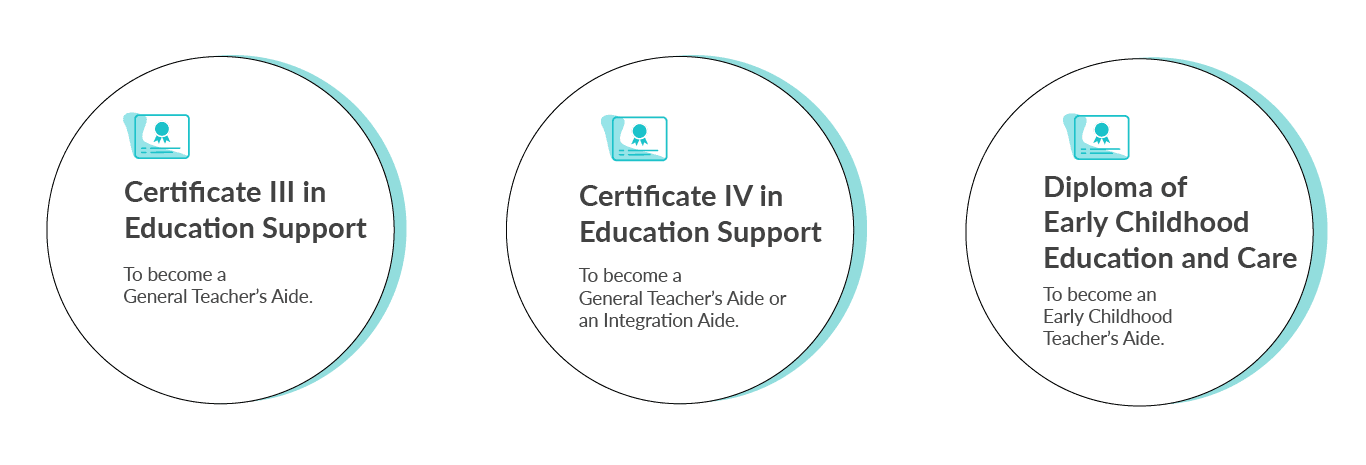
This qualification is considered the industry standard since it’s the minimum qualification required for the vast majority of teacher’s aide jobs.
In this certificate you’ll learn the basics of being a teacher’s aide. You’ll develop the technical skills necessary to perform a broad range of tasks, and work with children in a mainstream classroom.
Depending on which qualification you choose to complete, you’ll be expected to complete 100-120 hours of work experience. Julie-anne identifies her work experience to be one of the most integral parts of her training in becoming a teacher’s aide.
Work experience is all about applying what you learn during the course to real-life situations.
“We had specific things that we had to do in our placement for us to pass,” Julie-anne says. “We had to teach a certain thing to a small group. We also had to work with a specific child who has a disability or has difficulty learning while implementing the strategies we learnt during our course.”
On top of her studies and work experience, Julie-anne emphasises the value of personal development courses for staying ahead of the skills curve.
“ADHD is changing. Autism is changing. Everything is changing. We need to stay on top of things, which is why personal development is important.”
By complementing your teacher’s aide qualification with personal development courses such as a First Aid Certificate, CPR or Auslan Language class, you’re more likely to stand out from the crowd for future employers.
Free vs Paid Teacher’s Aide Courses: The Difference Explained
6. You’ll build relationships and make a difference
Julie-Anne’s love for her career comes from the relationships she builds with her students.
“You’re one of the first people they come to when there’s a problem because you created a relationship where they know that you’ll listen to them — you’ll hear them out. You will give them the time of day to hear what they have to say and then work with them to find a positive solution.”
Although not without its challenges, these hurdles often lead to the greatest sense of achievement.
“You really have to keep thinking and thinking all the time about your next move that can possibly help the student. When you overcome a learning hurdle with your student, you feel relieved. But there’s also that sense of achievement because you’ve created this strong bond with them.”
To take your first step towards this fulfilling career, explore Education Support and Early Childhood Education and Care courses
Browse Teacher’s Aide CoursesBrowse Education Results
Top Result
Graduate Certificate in Management
The Graduate Certificate in Management is an online postgraduate qualification that is designed for newer and ambitious professionals, with entry possible through management experience alone and a study structure that easily accommodates full-time work...

Study Method Blended, Online, Virtual
Location Adelaide South Australia +4
Job Outcomes People Management +3
Certificate III in Community Services (Perth Only) CHC32015
The Certificate III in Community Services is perfect for entry level community services workers who support individuals through the provision of person-centred services. Work may include day-to-day support of individuals in community settings or suppor...

Study Method In-class
Location Western Australia
Job Outcomes Community Support Worker +3
Certificate III in Fitness SIS30321
If you’re looking to begin your career in the fitness industry, studying the SIS30321 Certificate III in Fitness is the perfect qualification to get you started. Gain all the knowledge and skills you need to enter the industry as a Gym Instructor or Gr...

Study Method In-class, Online
Location Melbourne Victoria
Job Outcomes Personal Trainer +2
Personal Trainer Course SIS30321,SIS40221
Join the fitness industry as a Personal Trainer and turn your love for fitness into a rewarding career by graduating in both the SIS30321 Certificate III in Fitness & SIS40221 Certificate IV in Fitness. Enjoy the flexibility of being your own boss...
Study Method In-class, Online
Location Australian Capital Territory +7
Job Outcomes Personal Trainer +2
Certificate IV in Fitness (VIC Only) SIS40221
Take the next step in your career and gain the qualification you need to become a Personal Trainer. If you currently work in the fitness industry as a Gym or Group Fitness Instructor, elevate yourself to the next level by studying the SIS40221 Certific...
Study Method In-class, Online
Location Melbourne Victoria
Job Outcomes Personal Trainer
Certificate IV in Accounting & Bookkeeping FNS40222
Gain key practical skills to prepare you for a range of roles in the accounting sector. This qualification reflects the role of individuals in the accounting and bookkeeping industry, including business activity statement (BAS) agents and contrac...

Study Method Blended, Online
Location Anywhere
Job Outcomes Accountant +1
Certificate III in Accounts Administration FNS30322
During this course you will learn essential accounting fundamentals including processing financial transactions and extracting interim reports. It will also give you the skills and knowledge to complete key support functions like performing financial c...
Study Method Blended, Online
Location Anywhere
Job Outcomes Accountant
Bachelor of Health Science (Naturopathy)
Naturopathy is a whole medical system combining theory (philosophy and principles) and practise that uses an array of natural therapies to support healing and maintain health. Naturopaths aim to treat the underlying causes of illness and disease. The c...

Study Method In-class, Online
Location Adelaide South Australia +5
Job Outcomes Naturopath
Bachelor of Health Science (Clinical Nutrition)
Clinical nutritionists integrate traditional food wisdom and current scientific evidence to motivate individuals and communities to eat well and live healthier lives. The Bachelor of Health Science (Clinical Nutrition) is supported by a strong underpin...
Study Method In-class, Online
Location Adelaide South Australia +5
Job Outcomes Clinical Nutritionist corpor... +1
Certificate III in Individual Support (Ageing OR Disability) (Perth Only) CHC33021
If you have a passion for helping those most in need, this qualification is one way you can utilise your knowledge for the benefit of others. Package the Certificate III in Individual Support (Ageing or Disability) (CHC33021) to save time and gain know...
Study Method In-class
Location Perth Western Australia +2
Job Outcomes Care Assistant +4
Certificate III in Early Childhood Education & Care (Perth Only) CHC30121
If you love working with children and want to learn more about providing quality education and care in a range of environments, this course is for you. The Certificate lll in Early Childhood Education and Care (CHC30121) can provide you with an entry-l...
Study Method In-class
Location Perth Western Australia +2
Job Outcomes Early Childhood Educator +2
Certificate III in Non-Emergency Patient Transport (VIC Only) HLT31120
Our Promise We are confident in the delivery of our training. On successful completion of the course, graduates will be guaranteed a telephone interview for vacant Patient Transport Officer positions in the Non-Emergency Patient Transport division. So...
Study Method In-class
Location Melbourne Victoria
Job Outcomes Patient Transport Officer
Diploma of Community Services (Perth Only) CHC52025
The Diploma of Community Services qualification reflects the roles of community services, case management and social housing workers involved in the managing, co-ordinating and/or delivering of person-centred services to individuals, groups and communi...
Study Method In-class
Location Perth Western Australia
Job Outcomes Community Services Case Mana... +4
Certificate III in Allied Health Assistance (Perth Only) HLT33021
A Certificate III in Allied Health is your entrance into the world of health services! This course will teach you to support workers in a range of fields such as audiology to social work. You will use your qualification to gain an entry-level job in ei...
Study Method In-class
Location Perth Western Australia +2
Job Outcomes Physiotherapist Aide +4
Certificate III in School Based Education Support (Perth Only) CHC30221
Are you interested in becoming a teacher’s aide? Work with teachers to create a comfortable and supportive environment for children’s learning. You will ensure lessons run smoothly while also developing the student’s literacy, numeracy and resear...
Study Method In-class
Location Perth Western Australia +1
Job Outcomes Home Tutor +4
Certificate III in Individual Support (Perth Only) CHC33021
This qualification is for those who want to work in the community or in a residential setting, following a customised plan to give person-centred assistance to individuals who may need it due to ageing, disability or other circumstances. Work involves...
Study Method In-class
Location Perth Western Australia
Job Outcomes Aged Care Worker +4
Bachelor of Health Science (Acupuncture Therapies)
Acupuncture is a branch of Chinese Medicine that stimulates specific points on the body to regulate the flow of Qi (vital energy) to restore health and balance the functions of the body, mind and spirit. Acupuncture therapies combines Chinese medicine...
Study Method In-class, Online
Location Adelaide South Australia +5
Job Outcomes Acupuncture +4
Bachelor of Health Science (Chinese Medicine)
Chinese medicine is a whole medical system that seeks to balance the functions of the body, mind and spirit and restore health. It combines theory (philosophies and principles) and practices including acupuncture, moxibustion, medical Qi Gong, Chinese...
Study Method In-class, Online
Location Adelaide South Australia +5
Job Outcomes Acupuncturist +2
Diploma of Beauty Therapy (QLD Only) SHB50121
Turn your passion for beauty into a career that actually goes somewhere. The SHB50121 Diploma of Beauty Therapy is Demi International’s comprehensive beauty course — covering everything from skin science and facial treatments to massage, hair rem...

Study Method In-class, Online
Location Brisbane Queensland +4
Job Outcomes Graduates of the Diploma of ... +9
Certificate III in Hairdressing Course (QLD Only) SHB30416
Hairdressing is one of those careers where you see the impact of your work every single day — in the mirror, and on the face of your client. The SHB30416 Certificate III in Hairdressing gives you the technical skills and creative foundation to start yo...
Study Method In-class, Online
Location Brisbane Queensland +4
Job Outcomes A Certificate III in Hairdre... +6
Online courses also available
Loading...


Not sure which course to choose? Let us recommend the best courses to suit you!




Subscribe to Our Newsletter
Get expert advice, insights, and explainers on tricky topics — designed to help you navigate your learning journey with confidence.
By submitting this enquiry I accept the "Privacy Policy" and "Terms of Use"


